|
Agenda
and Speaking Faculty
|
|
Day
One: June 25, 2003
|
|
8:30
|
Registration
and Continental Breakfast |
|
9:00
|
Keynote
Address: Achieving Effective Performance Integration in Government
The Program Assessment Rating Tool (PART) evaluated the performance
of 234 programs for F04, by examining the four pillars of a program:
purpose, planning, management and results. The PART serves as a
tool to help integrate the budget and performance initiative as
outlined in the PMA. This keynote address will examine PART's overall
assessment for FY04 and look at the expectations by OMB and the
administration for FY05 and beyond.
Justine Rodriguez, Office of Management and Budget |
|
10:00
|
Integrating
PART to GPRA and PMA
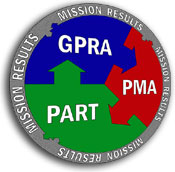
PART is a standardized, methodological tool that is evidence-based
in its assessment. In providing evidence, federal programs need
to turn to effective GPRA performance plans which serve as the blueprint
to performance planning and management. PART serves as a tool to
hold GPRA performance plans and PMA implementation progress accountable
by evaluating their success
Mortimer Downey, PB Consult, Former Chairman of the Performance
Measurement Advisory Council (PMAC) |
|
11:00
|
Break |
|
|
Step-by-Step
Application of PART
Facilitator: Carl
DeMaio, The Performance Institute/Reason Foundation
Program to be Studied: National
Weather Service
|
|
11:15
|
PART
Element One: Program Purpose and Design
Is the program's purpose and design clear and defensible?
Programs destined for failure are often maligned by a flawed purpose
and design. Inability to address a specific interest or need in
a program results in a lack of focus. Discuss how to ensure that
your program is starting off on the right foot by formulating a
strong, unique and defensible mission. |
|
12:15
|
Networking
Luncheon |
|
1:15
|
PART Element
Two: Strategic Planning
Are
valid long-term goals set for the program?
Through the passage of GPRA in 1993, government agencies are required
to draft a strategic plan to outline their long-term goals, yet
many of these goals remain vague. Learn how to establish meaningful
annual and long-term goals and performance measures in your GPRA
plan. |
|
2:15
|
PART
Element Three: Program Management
Are the agency's program management, financial oversight and
program improvement efforts successful?
To ensure that your agency is integrating performance and budget,
information needs to be collected and evaluated on your program.
To safeguard your agency against budget shortfalls and dwindling
performance, learn how to accurately collect performance information
as well as estimate and budget for your operation costs. |
|
3:15
|
Break |
|
3:30
|
PART
Element Four: Program Results
Are the performance goals set during strategic planning being
met?
In order to validate the success of your program's purpose, planning
and management, examine its results. Establish targets and actual
goals for performance and effectiveness. Learn how to reach performance
goals annually while continuing to plan for the future. |
|
4:45
|
Adjourn |
|
Day
Two: June 26, 2003
|
|
8:30
|
Continental Breakfast |
|
9:00
|
Step
One: Develop Mission, Outcome Goals, Intermediate Outcomes Using
Logic Model Methodology
• Define agency mission and purpose ensuring it
provides a unique, specific contribution
• Establish societal outcome for your program based on overall
purpose of the program
• Provide limited, yet clearly defined pieces of evidence
highlighting programmatic aims
Carl DeMaio,
The Performance Institute/Reason Foundation
|
|
10:00
|
Step
Two: Aligning Program Outputs and Activities to Program Goals
using a Logic Model Approach
• Successfully integrate budget and performance
using a resource tracking framework, such as Activity-Based Costing
• Establish definitive levels of products and services that
can be produced and measured within the program
• Define the actual workload level that is to be carried
out by the program and program partners
Carl
DeMaio, The Performance Institute/Reason Foundation
|
|
12:00
|
Luncheon |
|
1:00
|
Step
Three: Full Cost Accounting
•
Best practices on implementing the Activity-Based Costing
Management model (ABC/M) to support strategic and performance
plans
• Discover how to integrate ABC/M within the context of your
performance budgeting efforts
• Utilize the simplified approach to calculate cost-per-unit
output and correlate those costs to key strategies and outcomes.
Case
Study 1:
Cost Accounting Innovations at the Department of Veterans Affairs
Richard Norwood, U.S. Dept. of Veterans Affairs
Case Study 2:
Bureau of Land Management's Implementation of ABC/M
Betty Buxton, U.S. Dept. of Interior/Bureau of Land
Management
|
|
3:30
|
Networking
Luncheon |
|
3:45
|
Step
Four: Integration of PMA Initiatives
•
Align your strategic objectives and activities across PMA initiative
areas
• Communicate the PMA effectively across management silos
to successfully implement and track progress
• Fully tie-in agency GPRA plans to PMA progress
Jeffrey Bergin,
The Performance Institute
|
|
4:00
|
Adjourn |
Day
Three: June 27, 2003
Simulation Workshop |
|
Interactive Simulation
in Formulating and Justifying a Budget throughout the Entire Budget
Process
This simulation will cover topics encompassing the federal budget
process, focusing on involvement of numerous parties, such as
OMB, Congress, Budget Analysts and Interest groups. By working
in groups and utilizing “role play” scenarios, this
budget simulation will cover the following topics from budget
formulation to budget submission to budget acceptance:
• Overview of Federal Budget Process
• OMB Review and Passback
• Interest Groups and Interest Group Attacks
• Team Luncheon: Form Working Budget Teams and Roles
• Congressional Appropriations Hearing, Marking and Floor
Debate
• Controversial Appropriations Rider Added During Conference
Committee to Program Budget Request Drawing Presidential Veto
Threat
• Recap of Budgets
Use this budget simulation to learn the pitfalls and
valuable lessons when forming your performance-based
budget involving all principal actors.
|
|
 Or
by calling us at
703-894-0481 |
|


|
| Venue |
|
The
2003 Forum on Performance-Based Budgeting will be held at the
Performance Institute in Arlington, Va., just one block east of
the Courthouse Metro stop on the Orange Line. A public parking
garage is located inside the building.
The
Performance Institute
1515 N. Courthouse Rd.
Suite 600
Arlington, VA 22201
703-894-0481
A
continental breakfast and catered lunch will be provided for all
delegates.
|
| Hotel |
|
The
Performance Institute is located just two blocks from the Quality
Courthouse Hotel, where a limited number of rooms have been reserved
at a discounted rate of $129 per night. Please call the hotel
to make reservations, and be sure to ask for the Performance Institute
conference rate.
Quality
Courthouse
1200 N. Courthouse Rd.
Arlington, VA 22201
703-524-4000
|
| Tuition |
|
The
fee for attending the 2003 Forum on Performance-Based Budgeting
is:
| Forum
|
$1095 |
| Forum
and Simulation Workshop |
$1595 |
| Simulation
Workshop Only |
$500 |
|
| Group
Discounts |
|
Reduced tuition rates for delegates who attend in groups of three
or more are available by calling Bret Johnson at 703-894-0481, or
emailing him at [email protected]. |
Center
for Budget and Financial Management
Center
for Performance Management
|

 Part
of the Performance Institute's Government
Performance Series