Training Course:
Performance-Based Service Acquisition and Earned Value Management Systems |
Keep Your Projects on Target
to Achieve Cost, Schedule
and Performance Goals |
Government is now more results-oriented, particularly in the way which government contracts are written. One of the most important challenges facing agencies is the need for widespread adoption of performance-based contracting, but many acquisition personnel lack the necessary skills to develop and implement Performance-Based Service Acquisition (PBSA). The seven-step process for developing performance-based contracts simplifies the process and outlines the most efficient way to achieve the goals defined by OMB.The process also provides new insight on defining goals and improving transparency and accountability in government contracting that will produce results.
 Key Methodologies Covered
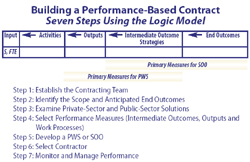
The performance-based contracting training is based on writing a contract that focuses on performance goals using the cutting edge seven-step framework which serves as a template for agency contracts. The Government Performance Logic Model is applied to define contract goals that will simplify the drafting of your Statement of Work (SOW), Statement of Objective (SOO) and Performance Work Statement (PWS).
|
| Training Curriculum |
| Day One Agenda: |
8:30 |
Registration & Continental Breakfast |
9:00 |
Update on Performance-Based Contracting Best
Practices and Requirements
• Understand the latest from the Office of Federal Procurement Policy and
legislation including the Services Acquisition Reform Act (SARA)
• Understand the Office of Management and Budget’s proposed rule on
earned value management
• Examine best practice models of performance-based contracts |
10:45 |
Step One: Establish the Team
• Benchmark the purpose, objective and projected outcome of a contract
• Clearly identify and define the roles and responsibilities of all participants,
including vendors
• Create a link between the program’s mission and it’s individual team
members |
12:00 |
Networking Luncheon |
1:00 |
Step Two: Decide which Problem Needs Solving
• Learn to effectively assess current levels of performance
• Determine the “end-outcome” of your contract
• Link acquisitions to organizational mission and performance objectives |
2:00 |
Step Three: Examine Private-Sector and Public-Sector
Solutions
• Conduct efficient and productive market-sector research
• Improve contract development by effectively utilizing private-sector input
before writing PWSs and crafting SOOs
• Apply experience from public-sector counterparts |
3:00 |
Step Four: Develop and Select Contract Performance
Measures
• Identify effective performance measures using the “SMART” performance
measure criteria
• Understand methodologies for developing end and intermediate outcome
performance measures using the Government Performance Logic Model
• Examine how performance measures can successfully motivate and manage government programs and contracts |
4:30 |
Adjourn |
| Day Two Agenda: |
8:30 |
Continental Breakfast |
9:00 |
Step Five: Develop a PWS and a SOO
• Learn the key components of a PWS and an SOO
• Hear effective techniques for comparing strengths and weaknesses of both
methods
• Gain essential insight regarding the development of a PWS or SOO |
10:45 |
Step Six: Select the Right Contractor
• Learn to interpret past performance to predict future results
• Determine the “best value” when presented with a diversity of proposed
services
• Tackle potential conflicts of interest |
12:00 |
Networking Luncheon |
1:00 |
Step Seven: Monitor and Manage Performance
• Learn to establish a clear line of performance accountability
• Incorporate the contractor into the team to improve results
• Maintain continued measurement during the contract to improve further
results |
2:30 |
Earned Value Management Overview: Methodologies,
Tools and Terminology
• Understand the importance of EVM and learn key tools and techniques
• Gain consensus on planned budget, cost, and performance targets
• Learn effective techniques for tracking progress and adapting to unplanned
obstacles |
4:30 |
Adjourn |
|
|
|
|
DESCRIPTIONS |
| Course Level: Intermediate |
| Delivery Method: Group-Live |
| Prerequisites: None |
| Advance Preparation: None |
CPE Credits: 12.5 |
| Tuition: $1095 |
| How You Will Benefit? |
Achieve compliance with OMB Mandates and the Federal
Acquisition Regulations
Identify key FAR and OMB requirements for Performance-based contracting and earned value management |
Create a Performance Statement of Work
Create specific and clearly defined
contract goals stated in terms of
desired results |
Devise Best-in-Class Performance Measures
Create effective performance
measures for your organization
that will motivate contractors and
deliver results |
Implement EVM Systems to Manage Contract Requirements
Develop and implement an
at-a-glance performance
measurement system to evaluate
government contracts |
| GET CERTIFIED |
The Performance Institute offers the only comprehensive certification programs.
The following training programs are also available:

 |
|
Continuing Professional Education Accreditation
Th e Performance Institute is registered with the National Association of State Boards of Accountancy (NASBA) as a sponsor of continuing education on the National Registry of CPE Sponsors. State boards of accountancy have fi nal authority on the acceptance of individual courses for CPE credit. Complaints regarding sponsors may be addressed to the National Registry of CPE Sponsors, 150 Fourth Avenue North, Nashville, TN 37219-2417. Web site: www.nasba.org |
|
|