| |
|
|
| |
The Performance Institute's Center for Human
Capital Strategy focuses specifically on building the skills
and capacities of HR managers and staff to enable them to
address the human resources management challenges they confront
on a daily basis. The center's area of focus includes: human
capital planning; employee performance evaluations and management
systems; workforce assessments; hiring flexibilities; compensation
reform; recruitment initiative design; performance measurement;
and internal change management.
Read More |
|

Performance Institute Tells Congress: Workforce Flexibilities
Require Human Capital Planning
In testimony Feb. 11 before the House Committee on Government
Reform's Subcommittee on Civil Service and Agency Organization,
Performance Institute President Carl DeMaio urged Congress to
integrate strategic human capital planning into legislation
that would provide agencies greater flexibility in recruiting
and retaining their best employees. The hearing, entitled "Espirit
de Corps," focused on H.R. 1601 and S. 129 — the
"Workforce Flexibility Act" — which would provide
more flexibility in setting pay rates for employees, provide
bonuses for recruitment and retention, and improve the management
of training activities.
 Read the Testimony in PDF

Defining the Role of HR in Competitive Sourcing
Tom Kaplan, competitive sourcing officer at the Office of
Personnel Management, spoke at HR Innovations 2003 on the importance
of linking together two core PMA initiatives: competitive sourcing
and the strategic management of human capital. Kaplan discussed
the impact of competitive sourcing on the federal workforce
as well as emerging trends, policies and roles that HR advisors
will have now and in the future.
 View
the Presentation in PowerPoint
Developing Customer-Oriented Leadership in Government: The
IRS Experience
At HR Innovations 2003, Dr. Jim Trinka, director of leadership
and organizational effectiveness at the IRS, delivered a presentation
that showed how the IRS is developing change leaders to improve
customer service and tax-enforcement. Since the program was
introduced, the efforts have yielded customer service ratings
that have more than doubled. Dr. Trinka discussed how great
leaders make a great difference in any organization. Successful
leaders must balance their roles and responsibilities across
core areas of leadership; employee satisfaction; customer satisfaction;
business results; equal employment opportunity; and diversity.
The IRS has identified 21 leadership competencies and linked
them to their core responsibilities.
View
the Presentation in PowerPoint
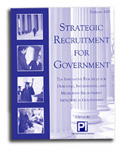 Strategic
Recruitment for Government
The Performance Institute today released "Strategic Recruitment
for Government," a 92-page research report detailing federal
agencies' efforts to fulfill the human capital component of
the President's Management Agenda and recruit enough quality
employees to stem the looming "human capital crisis."
Read More
Human Capital Planning and Workforce Assessment
At the "Human Capital Planning and Workforce Assessment"
training in August, Cheryl Gideon from the Government Accountability
Office (GAO) briefed the audience on GAO’s strategy to
become a first-rate employer and how they are becoming results-orientated.
Cheryl told the class how to use strategic human capital planning
as the foundation to transform any organization. She said that
with the future in mind and an appropriate planning process
any agency can become results-oriented, client-focused and employee-oriented
- to the benefit of Congress, the executive branch, and the
taxpayers.
View
the Presentation in PDF
Don Winstead from the Office of Personnel Management
Speaking at an HR Innovations 2004, Don Winstead from the
Office of Personnel Management (OPM) outlined the new OPM Senior
Executive Performance Regulations. These final regulations are
in conjunction with OMB and they are designed to assist federal
agencies in assuring that their senior employee performance
management systems make meaningful decisions based on relative
performance, thereby strengthening the linkage between performance
and pay.
View
the Presentation in PDF
We realize that bringing your whole office to a Performance
Institute event is not always practical, which is why the Institute
is proud to be able to customize its training programs and bring
them directly to your office! Using our staff of experts and
a faculty of instructors from government and the private sector,
the Performance Institute can tailor the curriculum of any program
to meet the specific needs of your department or agency.
Read More

The Strategic Management of Human Capital involves getting
the right people, with the right skills, in the right position,
at the right time, with the right incentives to perform the
right function. That’s a lot of “rights” to
get right.
Without effective management of human resources, government
agencies may face worker shortages, inadequate skills to meet
their missions, ineffective employee evaluation programs, and
loss of key managerial competencies to pending retirements.
To meet these challenges, the Performance Institute’s
expertise will assist agencies in implementing comprehensive
workforce planning and management processes aligned to the agency
mission.
Read More
|
|

| Leading
Organizational Change IN GOVERNMENT
January 20-21, 2005
Arlington, VA |
| Power
Presentations for Government Administrative Assistants
March 10-11, 2005
Arlington, VA |
Managerial
Cost Accounting for Government
April 11– 12, 2005
Arlington, VA |
| Diversity
Management FOR GOVERNMENT
April 18 – 19, 2005
Arlington, VA |
| Women
in Executive Leadership Executive in Government
March 29–30, 2005
Arlington, VA |
|
| |
|
|