|
The
Government Performance Logic Model
|
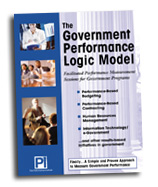
The
Institute has defined and refined a proven methodology
for measuring government performance: The Logic Model.
This prospectus
(in PDF format) provides an overview of how the Logic
Model works and how it can benefit your agency’s
efforts to define, plan for, manage, and measure program
performance.
|
|
Applying
the Logic Model to Your Agency's Challenges
While
the Logic Model has been used to devise implementation strategies
and performance measures for myriad government management challenges,
four applications of the Logic Model have been the most popular.
Each Logic Model session begins with comprehensive training for
program participants in the fundamentals of performance measurement.
Then, specific application training is provided to bridge performance
measurement with the management challenge being addressed by program
participants.
| Performance-Based
Budgeting |
| The
PBB Logic Model session provides a concrete approach to linking
resources to results through performance budgeting. This session
begins with a review of federal (or state/local) guidance
for performance budgeting, as well as examples from several
programs. Then, participants work through the logic model
defining outcomes, intermediate outcomes for program strategies,
and program outputs. In some sessions, managers are asked
to select work processes to which they “cost” their activities
using an approach similar to Activity-Based Costing. The result
is the alignment of performance and costs of a program in
a formal budget justification. |
Typical
PBB Deliverables:
• Program Performance Measurements
• Performance Justification for the Budget
• Self Assessment Score from OMB’s Program Assessment Rating
Tool - PART
• Activity-Based Costing Work Processes for Program Cost Alignment
to Results |
| Performance-Based
Consulting |
| During
this session, the PBC Logic Model is used to link contracting
and acquisition functions to program results. This session
begins with training on the “7 Steps for Creating Performance-Based
Contracts” developed by a consortium of federal agencies.
Then participants are asked to either work on their own contracts
or use a case study contract to develop a performance-based
Statement of Work or Statement of Objective. Participants
are also assisted in selecting what performance measures to
use in the solicitation and the contract vehicle and how to
structure contract incentives. |
Typical
PBC Deliverables:
• Statement of Work
• Statement of Objective
• Performance Measurements Linking Contract to Program Results
• Worksheet Applying Incentives to Contract Vehicle |
| Human
Resources Management |
| Workforce
assessments, human capital plans, recruitment and retention,
and employee evaluation initiatives all depend on aligning
workforce capacities to mission results. The HRM Logic Model
session address all four of these aspects of effective human
resource management in government. Participants evaluate strategies
and goals of programs to determine necessary skill sets and
workforce competencies. Measures for recruitment and retention
are applied to implement the human capital plan. In some sessions,
participants create actual employee performance contracts. |
Typical
HRM Deliverables:
• HR Performance Measures
•
SES/Executive Performance Plans
• Employee Performance Evaluation Plans
• Human Capital Plans
• Data Blueprint for Workforce Analysis
|
| Information
Technology/e-Government |
| Information
technology is an important, but expensive tool used to deliver
mission results. The IT/e-Gov Logic Model session begins with
training on an IT Capital Planning and Measurement framework
developed through agency surveys, GAO, OMB and CIO Council
efforts. Then the session turns to a specific IT investment
initiative or contract for the development of performance
measures aligned to program results. In some sessions, participants
work through an actual OMB Exhibit 300 or performance-based
IT contract model. |
Typical
IT/e-Gov Deliverables:
• e-Gov Performance Measures
• IT Performance Standards
• IT Capital Plan
• Budget/OMB Exhibit 300 Justification |
Go Back |
Read More
|