|

Download
a copy of the Institute's Human Capital Management Consulting
and Training Opportunities prospectus
(in PDF).
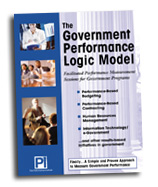
The
Institute has defined and refined a proven methodology for
measuring government performance: The Logic Model. This
prospectus (in PDF)
provides an overview of how the Logic Model works and how
it can benefit your agency'’s efforts to define, plan
for, manage, and measure program performance.
|
|
Contact:
Blake Zach at 703-894-0481
|
|
 Human Capital Management
Consulting and Training Opportunities
Available The Strategic
Management of Human Capital involves getting the right people, with
the right skills, in the right position, at the right time, with the
right incentives to perform the right function. That’s a lot of
“rights” to get right.
Without
effective management of human resources, government agencies may face
worker shortages, inadequate skills to meet their missions, ineffective
employee evaluation programs, and loss of key managerial competencies
to pending retirements. To meet these challenges, the Performance Institute’s
expertise will assist agencies in implementing comprehensive workforce
planning and management processes aligned to the agency mission. Among
the issues addressed by PI include:
1.
Human Capital Planning
Human
capital plans link HR processes to the mission requirements of the agency.
PI can assist with the development of a human capital plan that is in
alignment with the strategic plan and based on workforce analyses integrating
data on mission-critical skills and competency gaps. This will ensure
that agencies focus their human capital planning on strategies for recruiting,
retaining, and training employees contributing to the attainment of
agency mission goals.
2.
Employee Performance Evaluations and Management Systems
From
senior managers to line employees, government agencies must have systems
that recognize and reward individuals for outstanding performance, while
correcting inadequate performance. Most agencies do not possess adequate
or meaningful employee performance management systems. By making performance
evaluations measurable and outcome-based, agencies can ensure accountability
among employees and make distinctions between high and low performing
employees. To accomplish this, PI uses its Logic Model approach to ensure
that employee performance evaluations tier down from the agency strategic
plan and specific program performance goals—covering SES managers
and line employees.
3.
Workforce Assessments
Most
government agencies do not possess adequate workforce data to effectively
plan for, allocate, and manage their human capital. This process is
critical for the development of a human capital plan integrating strategies
for recruiting and retaining high-quality employees. PI can assist agencies
in conducting a thorough workforce assessment examining workforce size
and distribution, underrepresented demographic groups, rates of retirement
and turnover, and competency and skills gaps.
4.
Hiring Flexibilities, Compensation Reform, and Recruitment Initiative
Design
Streamlining
hiring and recruitment policies is key to winning the battle for a quality
workforce. Using its mastery of civil service flexibilities and the
latest hiring techniques, PI will work with agencies to ensure that
their strategic recruitment initiatives are based on workforce analyses
and human capital plans integrating strategies for filling mission-critical
skills gaps. PI promotes the development of recruitment initiatives
integrating strategies for using personnel flexibilities and incentives
and focusing on enhancing workforce diversity by targeting groups identified
as underrepresented within the agency.
5.
HR Performance Measurement
HR
processes must be efficiently and effectively managed and evaluated
to determine their contribution to the agency’s overall mission.
PI’s Logic Model Methodology promotes ongoing evaluation of human
resources processes, such as individual recruitment initiatives, to
ensure that agencies adopt the most effective strategies for recruiting
and retaining qualified candidates and make informed resource allocation
decisions.
6.
Internal Change Management
Every
agency faces difficulty managing internal change—from program reorganization
to redeployment of staff. To ensure successful implementation of changes,
PI will build the skills and capacities of human resources professionals
to ensure that they play an integral part in internal change management
by facilitating communications processes and working with employees
to anticipate the agency’s changing needs.
|