| |
|
Competition
Needed in California State Government (SCA-15)
Testimony Before
the California Senate Committee on Government Organization
April 20, 2004
Carl
DeMaio, President and Founder
|
| |
Good
morning. Mr. Chairman, members of the committee, I appreciate the
opportunity to appear before you today. My name is Carl DeMaio,
and I am the president and founder of The Performance Institute
- a private non-partisan think tank based in San Diego. The Performance
Institute focuses on improving government results through the principles
of performance, transparency, competition, and accountability. The
Institute has extensive expertise in the area of government performance
management, working with tens of thousands of federal, state and
local government managers every year to improve the performance
of their programs and agencies.
We
strongly support the legislation you are considering here today,
Senate Constitutional Amendment No. 15, which provides California
government the opportunity to “competitively source”
government services that may be more efficiently performed by an
outside provider.
Competition
in government is not about rolling back the important responsibilities
government has, but about reducing the cost of government while
improving its performance. In the end, it is about giving government
the tools to become a “smarter shopper” and using competition
to ensure the state’s best resources – whether public
or private – are tapped.
While
we fully support SCA 15, to be sure that non-profits and other governmental
entities can compete for work, we might suggest that a modification
be made. Accordingly, SCA 15 can be strengthened in Part A of Section
1 by replacing the words “the private sector” with “non-governmental
organizations or local governmental entities.” Doing so opens
the competition to non-profits and local government bodies that
might best be able to carry out those services.
Regardless
of who wins the competition, the average cost savings to government
is 30 percent. In the California Citizens’ Budget 2003-2005,
which The Performance Institute co-authored last spring, we documented
how if you chose state functions that have been successfully competed
in other governments could save nearly $9 billion in the budget.
SCA
15 will keep the door open for California to those tap in to those
savings. Our review of California’s Constitution has concluded
that competitive sourcing does indeed fit within existing legal
parameters. Passage of SCA 15 should put to an end the nagging questions
from opponents of competitive sourcing and allow the state government
to finally move forward with desperately needed competitions. We
recommend that this committee subsequently consider additional legislation
that would provide guidance on what services should be competed
and the process by which competitions are held. A transparent reporting
process should also be integrated into this legislation, ensuring
that the Senate and Assembly maintain proper oversight on contracts.
As
California moves forward with competitive sourcing, legislators
should consider the following recommendations adapted from The Performance
Institute’s October 2002 report, “Designing a Performance-Based
Competitive Sourcing Process for the Federal Government,”
which can be found in full online at www.performanceweb.org.
- Provide
a General Competitive Sourcing Framework that Creates Three Paths
to Competition
California should provide a general framework for how competitions
should be managed that provides three standardized paths for competition
while allowing maximum flexibility on how an agency pursues those
paths to competition.
Path
One: Direct Conversion
California should be allowed discretion to directly convert
an activity to non-governmental performance at any time for
any reason. In this case, the agency management would have
to marshal a clear business case as to why a decision to directly
convert an activity was so clear as to consider continued
government performance of the activity inappropriate.
Path
Two: Streamlined Competition Using Employee Conversion Organization
(ECO) Vehicles
In other cases, the agency may want to allow employees to
transition into an Employee Conversion Organization (ECO)
vehicle. Under this path, agency management would announce
a direct conversion and employees would have the opportunity
to form either a governmental or non-governmental vehicle
to compete for the work. Should the employees win, their vehicle
would be placed under contract and treated as a standard vendor
to the agency.
In
order to make the ECO approach work, employees would be given
a modest amount of support by the agency as they select their
vehicle for competition, e.g. employee stock ownership plan
(ESOP), transitional benefit corporation (TBC), etc. In addition
to having the option of creating a private entity, employees
could link up with a governmental or non-governmental vehicle
using an existing ECO already under government contract.
Path
Three: Public-Private Competition
The third path to competition would be used only when employees
are unwilling, or it is not practical, to convert to an ECO
vehicle. Under this path, a public-private competition would
take place where the public sector employees would compete
with private sector bids.
- Take
a Function-based Approach to Managing Competitions
A one-size-fits-all competitive sourcing process may not be the
best route for the California government. Calculating costs, analyzing
performance goals, and evaluating the competitive nature of a
bid can vary depending on different kinds of functions. A premium
should be placed on ensuring that a given activity is competitively
performed given industry standards for that activity. Evaluating
this question for a food service activity would be dramatically
different than evaluating the same question for an IT activity.
Put simply, the specific tools and techniques an agency uses to
determine whether an activity is competitively performed may differ
slightly based on the function being examined. As a result, California
should establish an overall competitive sourcing framework and
then promulgate best competition practices on a function-by-function
basis.
- Create
an Action-forcing Mechanism that Would Require Transparency and
Accountability for the Cost Performance of Contract Winners
At the moment, government pays very little attention to maintaining
timely and accurate data over the life of a contract. This leads
to little transparency and no accountability. In order for the
winning Most Efficient Organization (MEO) or contracting entity
to be held accountable for its performance and cost, contract
data, including personnel records, cost records, and workload
data, must be constantly and accurately maintained through an
action-forcing mechanism, such as a threat for re-competition.
The losing bidder of a competition should have the right to review
the performance and cost achievement of the winner over the life
of the contract by examining agency data. Agencies that do not
maintain these records should have to re-compete the contract.
Should the winning entity be partly responsible for the lack of
data, during the re-competition, it should be ineligible to compete.
After all, poor financial and performance management should disqualify
a bidder from the start.
- Communicate
Clearly the Need for Performance-based Competitive Sourcing
Competitive sourcing is controversial for government employees
from the get-go and presents a complex communications challenge
for managers. Deciding what to outsource inevitably raises philosophical
questions on the size, scope and appropriate role of government
in society. Without an effective communications and outreach initiative
in each agency, competitive sourcing initiatives might suffer
and fall victim to philosophically-motivated political debates.
- Use
Performance Measures in All Competitive Sourcing Initiatives
Competitive sourcing is ultimately designed to improve the performance
of government. As such, competitive sourcing initiatives should
yield cost savings (as defined by reduction in cost-per-unit output)
and/or improved performance(as defined by improved service levels
of outputs or enhanced impact on intermediate or end outcomes.)
Agencies must clearly define end, intermediate, and output performance
measures up front to guide the competition.
- Use
the Agency Human Capital Plan to Inform the Competitive Sourcing
Strategy
The agency’s competitive sourcing efforts should be aligned
to the agency’s human capital plan. Indeed, the development
of the competitive sourcing plan should occur concurrently with
the development of the human capital plan. In those commercial
activities where the agency identifies a current or projected
human capital shortage, competitive sourcing should be considered
as one process for either streamlining the function or converting
the function to an outside source where human capital can be accessed.
- Allow
workers to keep pensions and other benefits through innovative
vehicles such as an Employee Stock Ownership Plan (ESOP) and Transition
Benefit Corporation (TBC)
A major negative impact of competitive sourcing can be workers’
loss of employment and associated benefits. Total loss of benefits
need not occur. A number of innovative vehicles (such as TBC and
ESOP) could be accessed to transition employees into the private
sector complete with benefits.
- Support
Agency Competitive Sourcing Initiatives by a Change Management
Philosophy
It is vitally important that agency management employ change management
techniques in designing, implementing and communicating competitive
sourcing initiatives. Effective communications are vital to keeping
employees informed and involved in a change as potentially significant
as a competitive sourcing study. Most importantly, agency leadership
must ensure credibility in assuring workers that the agency views
individuals as valuable assets and take steps to reinforce that
view throughout the competitive sourcing process.
- Provide
Incentives and Bonuses for Employees through “Efficiency
Dividends”
Cost savings achieved during the first two years of a competitive
sourcing initiative should, in part, be invested into employee
bonus pools to be distributed with employees involved in successful
sourcing initiatives. Three kinds of bonus systems should be devised:
one for employees who staff a governmental ECO, one for employees
who win a traditional public-private competition, and one for
contract and program managers overseeing an outsourced activity.
Obviously in the first two cases the government would be recognizing
and rewarding innovative and efficient management by employees
after they win the competition. In the third case, the government
would be recognizing the importance of recruiting and properly
compensating business leaders at the contract and program management
level.
- Require
Agencies to Clearly Identify Risk Factors Relating to Commercial
Performance of an Activity that Reasonably Could be Deemed Inherently
Governmental and Prescribe Oversight Strategy
One way to create a solid business case around categorizing
activities as inherently governmental or commercial is to clearly
identify the risks to the public good in having a commercial entity
perform a certain inherently governmental activity. In addition
to stating the risks associated with outsourcing the activity,
the agency should certify that there is no reasonable means of
oversight and accountability that could be used in conjunction
with an outsourcing initiative. For example, risk could be mitigated
by an oversight board consisting of appointed officials and/or
through independent performance evaluations. Risk factors include,
but are not limited to, the following: assurance that official
rules of law are followed, national security concerns, establishment
or definition of government policy, civil liberty and privacy
concerns.
For
those risk factors identified for the activity, should the agency
decide to keep the function in-house, specific performance measures
should demonstrate how well the agency is managing those risks.
At the same time, the risk factors should be measured if the activity
is ultimately outsourced. In both cases, the agency will be accountable
for its decisions relating to inherently governmental activities.
- Allow
Agencies to Keep Cost Savings from Competitive Sourcing Automatically
By not allowing agencies to keep a substantial portion or all
of the savings, the competitive sourcing process provides little
funding for reinvestment in existing programs and provides no
positive incentive for undergoing competitive sourcing. Instead
of allowing agencies to keep the full amount of savings during
a two to three year period as some have suggested, it is better
to allow agencies to share in the savings (perhaps 50%) over the
five year period of performance of the contract. This would ensure
that agencies do not front-load cost savings in the first few
years and offset savings in the out years. Additionally, agencies
should be required to use their cost savings to reinvest in employee
development and other management improvement initiatives for the
agency.
- Create
a “Competition Corps” to Assist Agencies in Implementing
Competitive Sourcing Projects
California should create a “Competition Corps”
of highly trained competitive sourcing managers who would be assigned
to each study conducted by the agencies. Similar to the public
defender/ judge roles of the justice system, the Competition Corps
would assume two roles. One manager would be assigned to assist
employees in the development of an MEO or ECO and another manager
would serve as the independent reviewer of the proposals. The
Competition Corps would be financed by a fee charged to each agency.
By consolidating expertise for managing competition into a central
entity, the government can achieve economies of scale, foster
maximum competency for managing competitions, and ensure a consistently
applied process state-wide. Ideally, the Competition Corps would
be organized into “functional” Centers of Excellence
where staff would develop specific and honed expertise in management
improvement, cost calculation, performance measurement, and proposal
evaluation in key commercial activities.
- Set
Goals and Measure the Success of Competitive Sourcing Initiatives
Based on “Cost Efficiencies” and “Performance
Enhancements”
What gets measured gets done. Accountability for results is a
fundamental ingredient to drive management change in government.
Specific targets—when supported by thorough analysis—are
quite helpful. Targets should be bolstered by a business case
that takes into account cost drivers, program performance deficits,
changing customer needs, etc.
- Prioritize
Activities and Functions Scheduled for Competitive Sourcing Using
a Transparent Business Model
One way for agencies to identify where to begin applying competitive
sourcing, and later to help decide whether to use public-private
competition or direct conversion, is shown in the figure. If an
agency has done a good job of analyzing how important an activity
is to meeting the agency’s performance goals and also analyzed
how well the activity is performing, it can plot the activity
in the graph. The more important the activity is to the agency’s
overall performance, the higher on the graph it is. The better
the activity is performing, the farther to the right on the graph
it is.
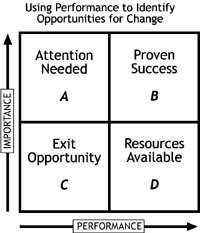 Based
on which box the activity falls into, an agency can determine
what opportunities for change may exist.
o Attention Needed—Activities plotted here are
important to the agency’s overall performance, but are
not performing very well. These activities are prime candidates
for competition designed to improve activity performance.
o Proven Success—Activities plotted here are
important to the agency’s overall performance and are
performing very well. Enough said.
o Exit Opportunity—Activities plotted here are
not important to the agency’s overall performance and
are not performing very well. The agency may choose to shift
resources to more important areas after ceasing these activities
and allowing the private sector to meet any demand for them.
o Resources Available—Activities plotted here
are not important to the agency’s overall performance
but are performing very well. The agency may have resources
and staff here that can deliver similar high performance in
more important activities and again may choose to shift resources
to more important areas after ceasing these activities and allowing
the private sector to meet any demand for them.
- In
Terms of Cost Calculation Methodology, Require the Use of Activity-Based
Costing (ABC) or Equivalent Cost Management System (OMB)
All commercial activities should be supported by activity-based
costing (ABC) or an equivalent costing system within three years
or should be placed on the priority list for competition or direct
conversion. As a requirement for public-private competition, ECOs
and MEOs should submit their bids consistent with an ABC or equivalent
costing system.
- Assess
Risk Factors to Government Bids when Assessing Them on Private
Bids
In order to maintain equivalency in the competitive process, risk
factors need to be determined and assessed to both the public
and private sector bids, requiring a more thorough and robust
technical evaluation of each bidding entity.
- Establish
a Clear Performance Framework for Each Activity Competed
No competition should be conducted unless clear measures of performance
are established for the activity being examined. The performance
measures used during the competition phase should be included
in the performance-based contract governing the winning bid.
The
Performance Institute is a private think tank seeking to improve
government performance through the principles of competition, accountability,
performance and transparency. The Institute serves as the nation's
leading authority and repository on performance-based management
practices for government. Its mission is to identify, study and
disseminate the leading management innovations pioneered by "best-in-class"
organizations.
Carl
DeMaio is President and Founder of the Performance Institute. He
is a nationally-recognized expert in government reform and performance-based
management.
|