Budget-Performance Integration

Consulting and Training Opportunities Available
Performance budgeting links agency budget resources with
performance results in a way that provides decision makers
and the public with a clear picture of whether they are getting
the “biggest bang for the taxpayer buck” from
individual government programs. If implemented properly, performance
budgeting can be the most transformational reform in government
management.
The Performance Institute has set the national standard in
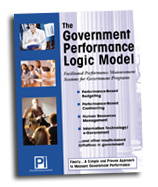
government performance budgeting through its “Logic
Model” approach to linking agency budgets to performance
results. PI training and consulting services address every
facet of performance budgeting, including:
1. Performance Measurement Development
At the heart of performance budgeting is the challenge
of devising timely, accurate, relevant and useful performance
information on individual agency programs. Through a mix
of training and facilitation, PI will help define programlevel
and agency-wide performance measures that meet the
following key criteria:
• Outcome-oriented: focus on core mission results
• Simple: Three to five “strategic” measures
or less per program
• Meaningful: Reflect key management challenges and
“tell the story” of each program
• “SMART”: Meet the “S-M-A-R-T”
criteria for methodological soundness for measure quality
and integrity
• Cost-relevant: tied to the core budget-program activity
structure
2. Full Cost Accounting
Government agencies are increasingly using Activity-Based
Consting is one financial accounting method of linking resources
to activities and processes. PI’s Logic Model approach
is enhanced to include work processes to which specific
activities are aligned which results in both performance
and costs of a program in a formal budget justification.
The result will be accurate, timely, useful and revealing
cost information provided to agency managers,
leaders and policy makers.
3. Integrated Financial-Performance Management Systems
To ensure accountability and use of performance information
for management, agency measures must be supported by a simple
and streamlined reporting system— that fully integrates
budget, financial and performance data. This need not be
a complicated process. By keeping measures to the “vital
few” and harnessing any existing and new agency IT
systems, PI has created fully integrated budget, financial
and performance management systems that allow for strategic
management within government.
4. Strategic Planning Facilitation
Obviously a key step at the beginning of any performance
budgeting process, the strategic plan must map the issue
environment an agency faces and establish a strategic rationale
behind its program activities. PI’s expertise in performing
issue landscape and program evaluation studies for agencies
as well as our standard methodology for facilitating stakeholder
dialogue, provide comprehensive solutions for agencies looking
to create an integrated strategic plan.
5. Performance Data Quality Improvement
Performance information is only as strong as it is reliable
and accurate. PI uses a maturity model to assess agency
performance information that sets “reasonable accuracy”
standards for performance information—an approach
that wins rave reviews from managers and auditors alike.
6. Individual Program Evaluations
Periodically, agencies will be under pressure to evaluate
the effectiveness of an individual program. PI forms expert
advisory boards to conduct in-depth program evaluations,
resulting in performance assessments, suggestions for reforms,
and improved performance measurements.
7. Budget Justification Development
The most relevant service provided by the Institute is
the development of budget justifications using solid performance
cases. PI’s ability to bridge political-career and
executive-legislative mindsets is a main element of its
success in creating strong budget justifications. PI can
provide training, facilitation, or reviews and comments
on budgets. It can also “model” alternative
budget structures and ways of presenting and justifying
budget requests based on feedback of appropriators, stakeholders
and other budget reviewers.
|