Leading Organizational Change
Managing organizations during times of major
change is the greatest challenge that leaders face. Continuous,
overlapping change often causes losses in productivity,
morale problems, increases in turnover and dysfunctional
behavior. Leaders must learn how to not only manage change,
but also how to manage the inevitable human transitions
that people experience when faced with significant change.
Whether it comes through strategic planning or as a response
to outside events, change must be managed effectively to
achieve organizational excellence. Participants in this
training will learn how to deal with these dual challenges
and how to lead their organizations through the change process.
Key Methodologies Covered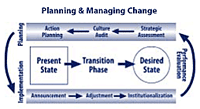
This training will focus on developing a change
management strategy that is aligned with organizational
mission and focuses on bottom-line results. At the end of
this interactive training participants will be able to identify
key concepts of organizational change and understand the
dynamics at work within their organizations.
| Training
Curriculum |
| Day
One Agenda: |
| |
Registration & Continental
Breakfast |
| |
Understand the Process of Organizational
Change
• Identify the frameworks required to manage change
in your organization
• Develop a strategy to differentiate between
change and transition |
| |
Role of the Change Leader and Implementation
Team
• Solidify senior leadership and stakeholder support
for an integrated change process
• Evaluate risk and assess the critical elements
of change |
| |
Plan for Change: Align Your Change Management
Initiative with Organizational Strategy
• Implement a change management plan to drive
organizational results and enhance performance
• Create clearly defined end outcomes and develop
strategies to meet your change management initiative |
| |
Assess Internal and External Resistance
to Change
• Evaluate risk and assess the critical elements
of change
• Ensure your organization can sustain change
by building individual resilience |
| |
Build the Case for Change that Directly
Addresses Points of Resistance
• Involve people in developing long-term objectives
and planning for change
• Share power with team members and others to
encourage the implementation of the change efforts |
| |
Adjourn |
|
Day Two Agenda: |
| |
Continental Breakfast |
| |
Develop an Effective Communications Strategy
to Lead Change
• Examine how to best communicate your change
initiative to your internal workforce, external stakeholders
and taxpayers
• Create employee buy-in and decrease resistance |
| |
Establish Accountability for Change Implementation
• Ensure agency mission and visions are consistent
with long-term “values”
• Institute a bottom-up process for reorganizing
systems and processes
• Develop performance measures that are specific
and accountable |
| |
Invest in Training to Facilitate Change
Implementation
• Identify the core competencies required to develop
and implement an organizational vision
• Identify and integrate key issues affecting
the organization |
| |
Evaluate the Change: Assessing Organizational
Response and Performance: Ongoing Assessment of Decision
Making and Change Initiatives
• Establish quarterly reviews to re-assess performance
measures and the execution of the strategic plan
• Continue constant internal and external communication
to deliver key messages concerning project implementation |
| |
Case Study: Developing Change Leaders
Learn how to use leadership development programs to
counter the loss of institutional knowledge and identify
future leader |
| |
Adjourn |