| |
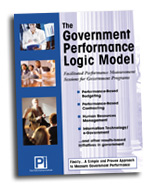
What is the Logic Model?
The Logic Model is a framework for planning, managing, measuring
and evaluating government programs. Using a goal-measure approach,
it illustrates the cause-effect linkages between program activities
and outcome results. A Logic Model is developed for each program
within an agency, providing measures for use in employee evaluations,
IT management, program evaluation, budget justification and
contracting.
How is a Logic Model
Developed for my Program?
Institute performance measurement facilitators lead your program
staff through the development of a logic model while program
staff drive the development and selection of the performance
measures. This participatory approach has won praise from
employees, managers, stakeholders and elected leaders for
keeping performance measurement simple and meaningful-while
simultaneously providing a framework for making substantial
program performance improvements.
How Long Does it Take
to Complete the Logic Model?
Most Logic Model sessions require one to two days- depending
on the complexity of the agency program and the intended use
of the performance measures. Because the Institute's facilitation
approach emphasizes internal capacity-building, the agency
can continue refining its Logic Model outside of the Institute's
facilitated Logic Model sessions.
What Deliverables Will
My Agency Receive?
Deliverables will differ based upon the approach requested
by individual agencies, but each Logic Model session ends
with at least a list of performance measures for use by the
program managers. Additionally, some Logic Model sessions
also provide drafts of key agency documents such as statements
of work, budget justifications, IT capital plans, employee
evaluation templates, etc.
Is the Logic Model
Compatible with Other Measurement Approaches?
Absolutely. The Logic Model is fully compatible with any other
measurement approach, including the Balanced Scorecard. The
Logic Model provides the structure and linkage where other
measurement methodologies do not.and in doing so provides
for the integration of program management, budgeting, technology,
acquisition and human resources into one management system.
Who Else is Using the
Logic Model Approach?
The Logic Model has emerged as the preferred approach to developing
performance measures in government. It has been used for years
in the professional evaluation community, as well as referenced
by the Office of Management and Budget and National Academy
of Public Administration. Numerous federal, state and local
agencies have adopted the Logic Model as their official planning
and measurement approach.

Applying the Logic
Model to Your Agency's Challenges
While the Logic Model has been used to devise
implementation strategies and performance measures for myriad
government management challenges, four applications of the
Logic Model have been the most popular. Each Logic Model session
begins with comprehensive training for program participants
in the fundamentals of performance measurement. Then, specific
application training is provided to bridge performance measurement
with the management challenge being addressed by program participants.
Performance-Based
Budgeting |
The PBB Logic Model session provides
a concrete approach to linking resources to results
through performance budgeting. This session begins with
a review of federal (or state/local) guidance for performance
budgeting, as well as examples from several programs.
Then, participants work through the logic model defining
outcomes, intermediate outcomes for program strategies,
and program outputs. In some sessions, managers are
asked to select work processes to which they "cost"
their activities using an approach similar to Activity-Based
Costing. The result is the alignment of performance
and costs of a program in a formal budget justification. |
Typical PBB Deliverables:
. Program Performance Measurements
. Performance Justification for the Budget
. Self Assessment Score from OMB's Program Assessment
Rating Tool - PART
. Activity-Based Costing Work Processes for Program
Cost Alignment to Results |
Performance-Based
Consulting |
During this session, the PBC Logic Model
is used to link contracting and acquisition functions
to program results. This session begins with training
on the "7 Steps for Creating Performance-Based Contracts"
developed by a consortium of federal agencies. Then
participants are asked to either work on their own contracts
or use a case study contract to develop a performance-based
Statement of Work or Statement of Objective. Participants
are also assisted in selecting what performance measures
to use in the solicitation and the contract vehicle
and how to structure contract incentives. |
Typical PBC Deliverables:
. Statement of Work
. Statement of Objective
. Performance Measurements Linking Contract to Program
Results
. Worksheet Applying Incentives to Contract Vehicle |
Human Resources
Management |
Workforce assessments, human capital
plans, recruitment and retention, and employee evaluation
initiatives all depend on aligning workforce capacities
to mission results. The HRM Logic Model session address
all four of these aspects of effective human resource
management in government. Participants evaluate strategies
and goals of programs to determine necessary skill sets
and workforce competencies. Measures for recruitment
and retention are applied to implement the human capital
plan. In some sessions, participants create actual employee
performance contracts. |
Typical HRM Deliverables:
. HR Performance Measures
. SES/Executive Performance Plans
. Employee Performance Evaluation Plans
. Human Capital Plans
. Data Blueprint for Workforce Analysis |
Information
Technology/e-Government |
Information technology is an important,
but expensive tool used to deliver mission results.
The IT/e-Gov Logic Model session begins with training
on an IT Capital Planning and Measurement framework
developed through agency surveys, GAO, OMB and CIO Council
efforts. Then the session turns to a specific IT investment
initiative or contract for the development of performance
measures aligned to program results. In some sessions,
participants work through an actual OMB Exhibit 300
or performance-based IT contract model. |
Typical IT/e-Gov
Deliverables:
. e-Gov Performance Measures
. IT Performance Standards
. IT Capital Plan
. Budget/OMB Exhibit 300 Justification |
Benefits of Scheduling
a Logic Model Session
| |
Customized:
Logic Model sessions are devised with specific agency
needs in mind, to provide a tailored solution |
| |
Outcome-Oriented:
Hands down, the Logic Model is the best approach for
starting with end outcomes and aligning back to program
activities |
| |
Streamlined:
Sessions deliver results in one, two or at most three
days' time |
| |
Capacity-Building:
Participants are trained in the methodology so they
can apply it to other measurement challenges |
| |
Cost-Effective:
Sessions are billed under training agreements with agencies
providing the most costeffective vehicle |
| |
Scaleable:
The Logic Model session can be "tested" in
one program area or management challenge |
| |
Simplified:
Performance measures are limited to the vital few that
inform key management decision making |
| |
On-Target:
Institute approaches are cutting edge and in line with
federal, state and local guidance on performance management |
|
















 As
the nation's largest think tank dedicated exclusively to government
performance, the Performance Institute works with government
agencies to develop and use meaningful performance measures
for nearly every operational function and every mission area
in government.